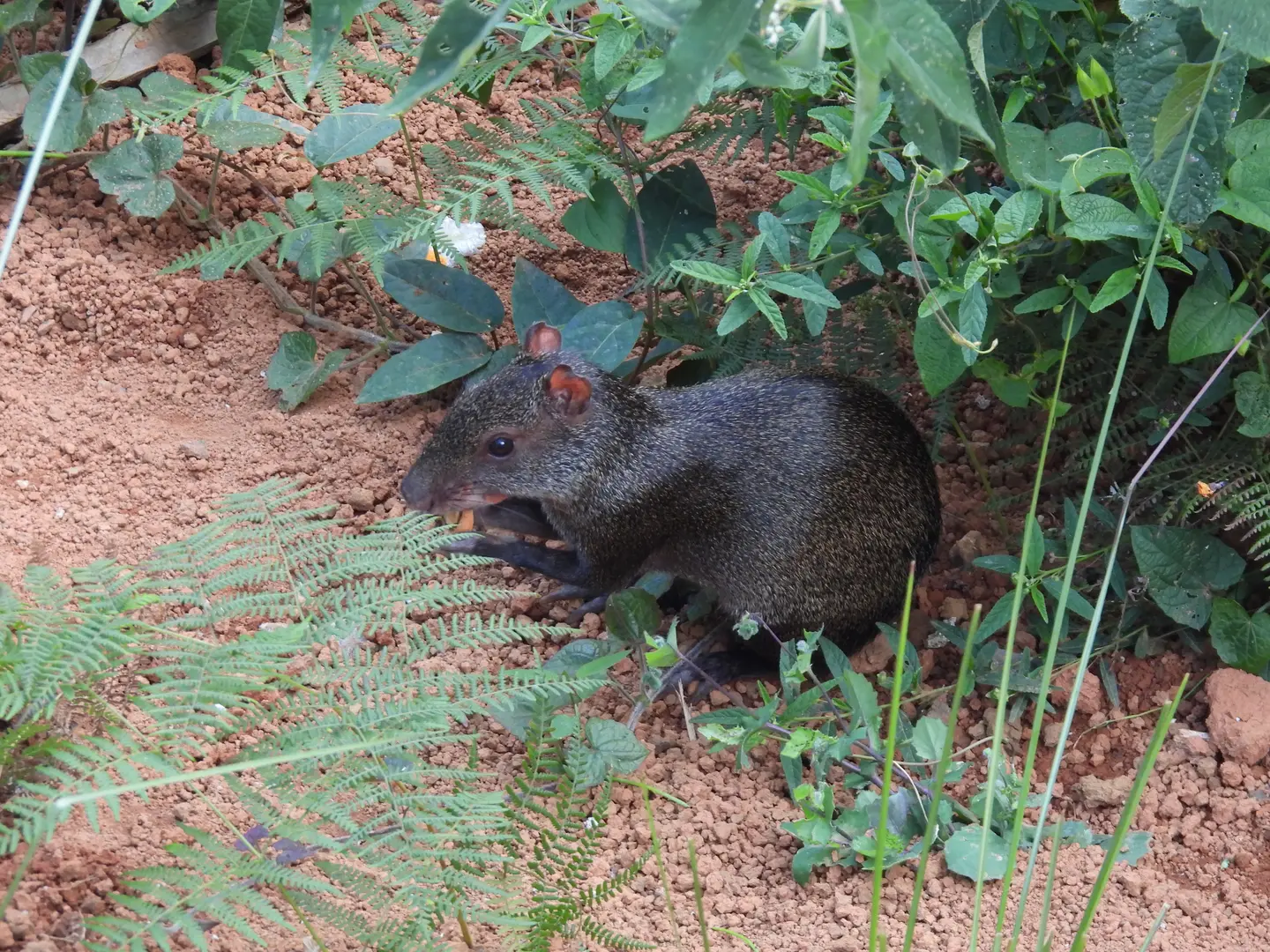
When an agouti, known in Cali as a guatín, picks up a seed beneath a tree, it can eat it on the spot or bury it for another day. That second choice can give the forest a new tree. If the seed stays buried long enough, it has a chance to sprout away from where it fell. Cali’s environmental agency, DAGMA, lists the agouti among the seed dispersers of the Meléndez River basin.
The seed stores of La Buitrera
The Meléndez municipal reserve stretches across part of Comuna 18 and the rural district of La Buitrera, in southern Cali. A photograph taken in June 2014 (opens in a new tab) caught an agouti nosing through the plants at the edge of a garden in Girasoles, a part of La Buitrera. The cover photograph gives a closer look at another agouti in Cali. Notice how it holds its food between its front paws as it eats.
The Central American agouti (Dasyprocta punctata) spreads its food reserves across shallow holes in the ground. By the time it comes back for a seed, another agouti may already have dug it up and carried it off to bury elsewhere. For a seed, being stolen can be the start of quite a journey.
Following a palm seed in Panama
On Barro Colorado Island in Panama, ecologist Patrick Jansen and his colleagues attached tiny radio transmitters to palm seeds and set up cameras to watch the hiding places. They followed one seed that the rodents buried 36 times. Its trips added up to more than 749 meters. After 209 days, an agouti finally dug it up and ate it.
Other seeds survived underground. By the time one takes root far from the parent palm, it may have passed through several pairs of paws. If you spot an agouti carrying something in its mouth, give it room and watch for a moment. You might see where it decides to keep its next meal.
To find the Meléndez and follow its course through southern Cali, see our guide to the city’s seven rivers.
Sources
- DAGMA, guide to the Meléndez River municipal reserve, 2018 (opens in a new tab).
- Patrick Jansen and colleagues, study of agoutis and palm seeds on Barro Colorado Island, published in PNAS on July 16, 2012 (opens in a new tab).
- Sahaquiel9102, photographic record of an agouti in La Buitrera, Cali, June 9, 2014 (opens in a new tab).