Put on “La diabla” (The She-Devil) and listen for the low notes that keep circling back beneath the voices. Following that one sound is a good way into the marimba music of Cali’s Petronio Álvarez festival. This recording comes from the 1999 edition at Los Cristales, the city’s open-air theater. Alborada de Guapi, a group from the coastal town of Guapi in Cauca, took third place in the marimba competition that year. Play the excerpt in the Señal Memoria sound archive (opens in a new tab).
Two players can share a single marimba
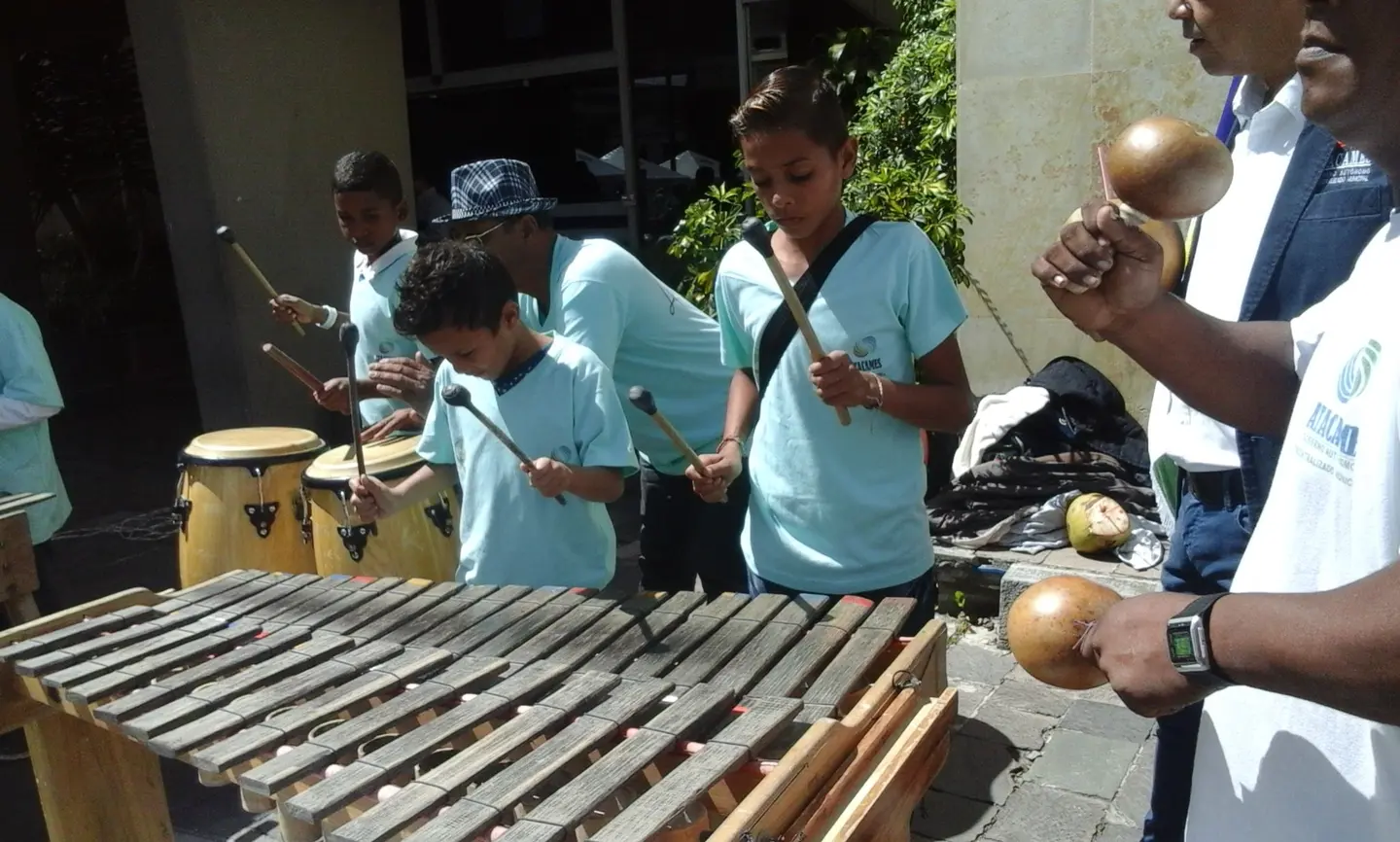
In the cover photo, two young musicians play the same row of wooden bars. The instrument comes from Esmeraldas in Ecuador, where Afro-descendant communities share a musical tradition with their neighbors on Colombia’s southern Pacific coast. Each bar is made of chonta palm wood. Bamboo tubes hanging beneath the bars let the struck notes resonate.
Try humming the bordón, the low phrase that repeats with slight variations. Once you can anticipate its return, turn your ear to the higher notes. That’s the requinta, the part that gives the player room to vary the melody. To hear it on its own, watch marimba player Héctor Tascón demonstrate the requinta in A marimbiar (Let’s Play Marimba) (opens in a new tab).
Watch the hands to tell the drums apart
A cununo player uses palms and fingers on an upright drum with a single head. In a traditional ensemble, one cununo keeps a dry, steady pattern. The other, called the repicador, answers the marimba. When the melody changes, listen for what the drummer plays back.
The bombo is a drum with a head at each end. The player uses a stick and a round-headed mallet called a boliche. Listen for two different jobs in the ensemble. The arrullador drum holds a pattern steady across several bars. The golpeador drummer can improvise and mark the end of a phrase.
Listen for the guasá underneath the singing
That fine rattling sound under the voices is a guasá, a bamboo shaker traditionally played by the singers themselves. With each shake, seeds strike small rods inside the tube. Play the Alborada de Guapi excerpt again and try tapping that pulse with one hand while you follow the singing. The piece is a juga, a musical form from Colombia’s southern Pacific coast.
To plan a visit, see what Cali has announced about the next Petronio Álvarez festival.
Sources
- Señal Memoria, notes on the Alborada de Guapi recording, July 24, 2014 (opens in a new tab).
- Héctor Javier Tascón Hernández, A marimbiar, Instituto Departamental de Bellas Artes, 2008 (opens in a new tab).
- Colombian Ministry of Culture, ¡Qué te pasa vo! Canto de piel, semilla y chonta, introduction to Pacific coast music, 2009 (opens in a new tab).
- UNESCO, inscription of marimba music from Colombia’s southern Pacific coast and Esmeraldas, 2015 (opens in a new tab).