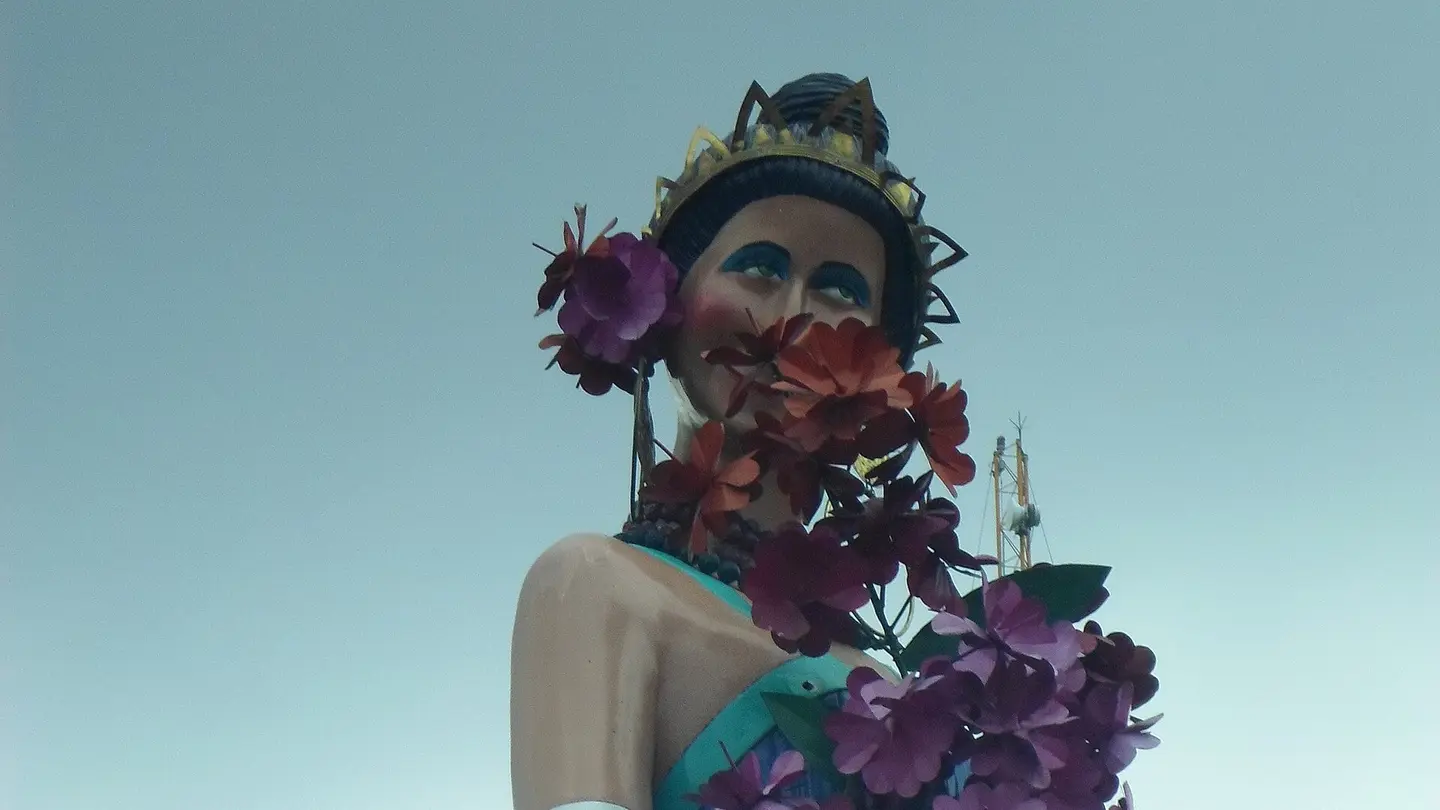
Cali has had many beauty queens, but only one eternal queen. Jovita Feijóo never won an official pageant and died without a home of her own, yet she won the affection of the whole city. She died in 1970 and is still on Calle 5 as a statue, in Fernell Franco’s photographs, in a novel reissued some fourteen times and in the museum of the Cementerio Central, where she rests.
Key facts
- Name: Jovita Becerra Feijóo, known as Jovita Feijóo. The Valle del Cauca government records her first name as Jovina.
- Born: June 6, 1910, in El Bolo Alizal, a corregimiento (rural district) of Palmira, Valle del Cauca.
- Died: July 15, 1970, in Cali, aged 60.
- Her titles: Reina de la Simpatía (Queen of Charm), queen of the mechanical engineering students, Reina de Reinas (Queen of Queens) and Cali’s eternal queen.
- Where to remember her: her statue in the Parque de los Estudiantes, on Calle 5, and her grave in the Cementerio Central, open daily from 9:00 a.m. to 3:00 p.m., free.
From Palmira to Cali: a family that lived by doing other people’s laundry
Jovita was born into a poor family and went to primary school in Palmira. Her father, Pacífico Becerra, abandoned the family, and her mother, Joaquina Feijóo, raised her daughters by doing other people’s laundry.
According to the Valle del Cauca government, she came to Cali in the 1930s. She worked as a domestic worker and, the story goes, fell in love with her employers’ dresses, gloves, shoes and headpieces. She dreamed of being a singer.
Her first crown came from a Radio Higeronia host
That dream took her to La hora de los aficionados (The Amateur Hour), a singing contest on Radio Higeronia, broadcast from the Plaza de Caycedo. Jovita sang “La palmirana” and went off-key: the host played the howling-dogs sound he saved for singers who missed the notes.
Jovita didn’t leave the stage. She kept singing with the dignity of an empress, and the host, to calm her furious stare, proclaimed her “Reina de la Simpatía” (Queen of Charm). The radio carried the news across Cali, and she took the title very seriously.
Parades, derbies and presidents: a queen in the streets
From then on, she strolled around the city elegantly dressed, in the clothes and jewelry that high-society ladies gave her. On the street, people called her “Your Majesty.”
According to Radio Nacional, she led the Feria de Cali parades, sometimes blowing kisses from the fire truck, and made the ceremonial kickoff at the América vs. Deportivo Cali derbies. She was welcomed at the exclusive Club Colombia and Club Campestre. When presidents such as Eduardo Santos, Gustavo Rojas Pinilla or Carlos Lleras Restrepo came to town, she was first in line for a photo with them, though not before passing on the complaints of Cali’s people.
She also volunteered with the Red Cross and attended neighborhood council meetings. In her last years, she received help from the Church’s charities.
Some people took her for a madwoman, and others mocked her. Poet Javier Tafur, her biographer, summed it up: “There are people who follow the formalities, who are afraid of looking ridiculous. Not Jovita.”
1968: the mechanical engineering students made her their queen
In 1968, mechanical engineering students at Universidad del Valle had to nominate a classmate for the university pageant. Since no women were enrolled in their department, they nominated her.
The university crown went to another candidate, but on Saturday, April 27, 1968, Jovita was crowned “Queen of Charm” and remained the queen of Mechanical Engineering. On May 1, according to El País at the time, she visited the newspaper with her entourage of students and announced she was drafting her first “royal decree”: she would ask the government to help students and to fund a cafeteria and laboratories for the department.
July 15, 1970: the funeral that brought Cali to a standstill
Jovita never owned a home. In early 1970, journalist José Pardo Llada organized a fundraiser to buy her one, and people gave 4,593 pesos. She didn’t live to move in: she died of a heart attack on the morning of July 15, 1970.
Her funeral brought Cali to a standstill. Her wake was held at a funeral home on Avenida Vásquez Cobo, where she lay dressed in white, as at her first coronation, and hundreds of people followed her coffin to the Cementerio Central, where she rests.
Where Jovita lives on: a statue, a novel, photographs and the Carnival
- In a statue: “Jovita Reina Infinita” (Jovita, Infinite Queen), by Cali artist Diego Pombo, was unveiled on December 31, 2007, in the Parque de los Estudiantes, on Calle 5, across from the Colegio Santa Librada school. It showed her with a crown, long gloves, a turquoise dress and a large bouquet of flowers. In 2021, during the national strike, the dress was painted black. Pombo explained that it was part of a redesign agreed with the city’s culture department: the statue would be renamed “Jovita, reina de los estudiantes” (Jovita, Queen of the Students) and carry gold stars in memory of the young people killed in the protests. That year, the city said there was no budget to finish it.
- In a novel: poet Javier Tafur González told her life story in Jovita o la biografía de las ilusiones (Jovita, or the Biography of Illusions), published in 1976 and reissued some fourteen times since.
- In art: she appears in Fernell Franco’s photographs, and her portrait is kept in the museum of the Teatro La Concha, in San Antonio.
- At the Carnival: at the Carnaval de Cali Viejo (Old Cali Carnival) on December 28, 2025, the city listed her among the icons of Cali’s history who paraded. The 2026 edition is also on December 28, as we explain in our Feria de Cali 2026 guide.
Jovita’s route through downtown Cali
- Plaza de Caycedo: the radio station where she received her first crown broadcast from here.
- Parque de los Estudiantes: her statue, on Calle 5, across from the Colegio Santa Librada.
- Cementerio Central: her biography is one of eleven in the new interactive museum, which you explore by scanning QR codes with your phone. It’s open daily from 9:00 a.m. to 3:00 p.m., and entry is free. More in our story on the Cementerio Central museum.
- The stadium: next time you go to an América vs. Cali match, remember there was once a queen who made the ceremonial kickoff. Catch up on the history of Cali’s football derby.
Did you or your family know Jovita?
Many Cali grandparents have a Jovita story: they saw her in a parade, ran into her on a bus or had their picture taken with her. Email us at chrisavendano0508@gmail.com and tell us yours, or the one your family told you.
Frequently asked questions
Who was Jovita Feijóo?
A woman born in Palmira in 1910 who became one of Cali’s best-loved characters. She was crowned in a radio contest and at Universidad del Valle, and the city adopted her as its “eternal queen.”
Where is Jovita’s statue?
In the Parque de los Estudiantes, on Calle 5, across from the Colegio Santa Librada school. It’s called “Jovita Reina Infinita” and is the work of Diego Pombo, who proposed renaming it “Jovita, reina de los estudiantes” in 2021.
Where is Jovita Feijóo buried?
In Cali’s Cementerio Central. Her biography is part of the interactive museum the cemetery opened on November 2, 2026.
When did Jovita die?
On July 15, 1970, of a heart attack, aged 60.
Why is she called the eternal queen?
She never won an official pageant, but she behaved like a queen her whole life, and the city accepted her as one. More than fifty years after her death, caleños, as people from Cali are called, still call her that.
Sources
- Radio Nacional de Colombia — Jovita Feijóo, Cali’s eternal queen, September 4, 2020 (opens in a new tab). Quotes El País coverage from May 1, 1968.
- Valle del Cauca government — Tribute to Jovita Feijóo, “the Inspiring Queen,” June 13, 2020 (opens in a new tab).
- El País Cali — the new edition of Javier Tafur’s Jovita o la biografía de las ilusiones, October 29, 2020 (opens in a new tab).
- El País Cali — Diego Pombo: Jovita’s statue wasn’t vandalized and will get a new design, July 9, 2021 (opens in a new tab).
- Universidad Icesi — Natalia Vargas Reyes, Jovita Feijóo: reinterpretation and representation of the popular figure of Cali’s Eternal Queen, 2022 (opens in a new tab).
- Wikipedia (Spanish) — Jovita Feijóo (opens in a new tab).
- 90 Minutos — 55 years since Jovita Feijóo said goodbye, July 15, 2025 (opens in a new tab).
- Cali City Hall — Cementerio Central, where Cali’s memory rests, July 30, 2025 (opens in a new tab).
- Cali City Hall — Jovita, el Loco Guerra and other icons of Cali’s history at the Carnaval del Cali Viejo, December 28, 2025 (opens in a new tab).
- CaliSucursal: Cementerio Central de Cali, new free interactive museum, November 7, 2026.