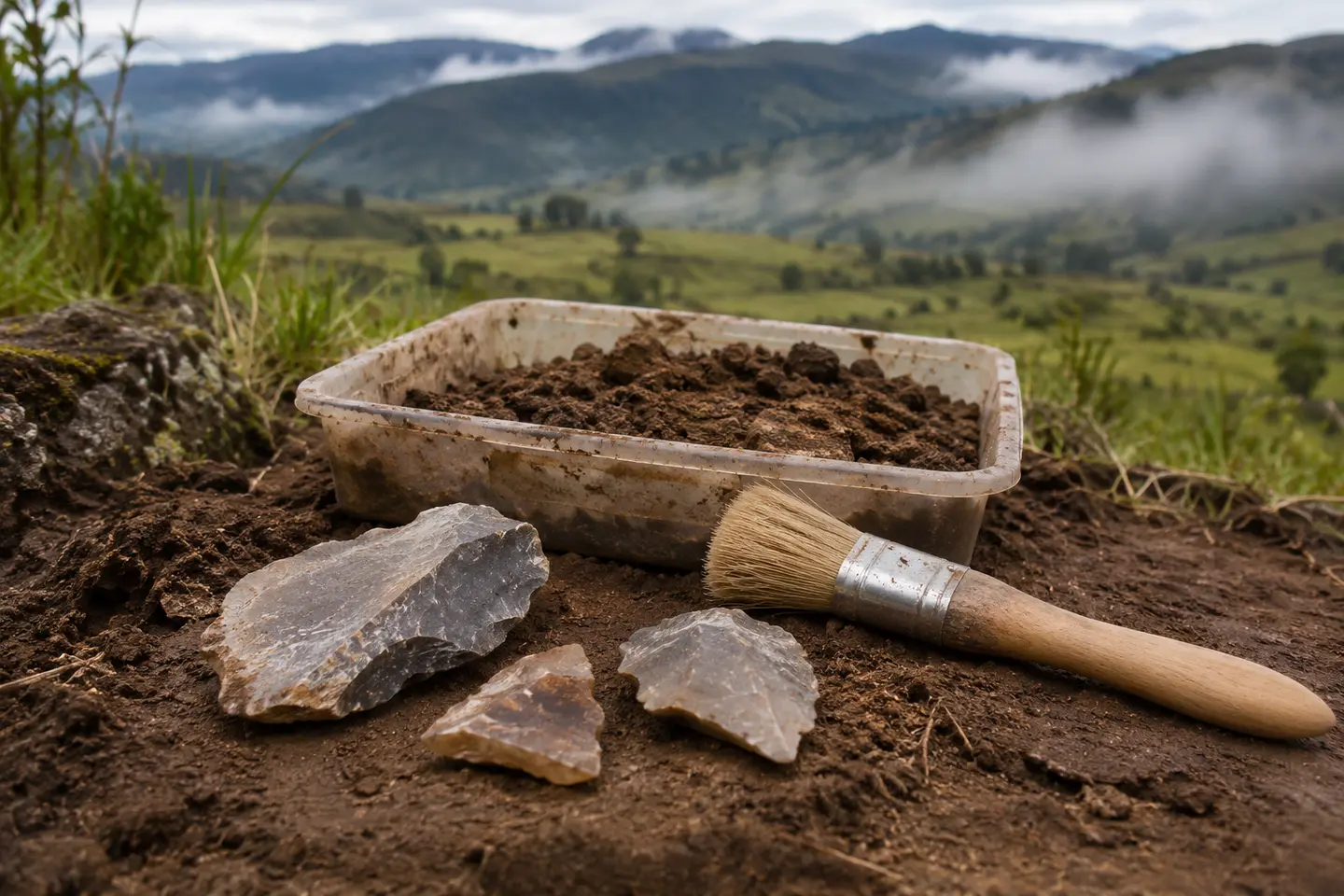
About 6,000 years ago, on the high plateau surrounding Bogotá, there lived a group of hunter-gatherers whose genetic signature does not appear in any other known people of the Americas, ancient or present-day. That was the conclusion of a team from the Universidad Nacional de Colombia, the University of Tübingen and the Senckenberg Centre, both in Germany, in a study published in May 2025 in the journal Science Advances (opens in a new tab). They are the first ancient human genomes from Colombia to appear in a scientific publication.
Seven skeletons from Checua hold the key
The researchers analyzed DNA from the bones and teeth of 21 people found at five archaeological sites on the Altiplano Cundiboyacense (the high plateau of Cundinamarca and Boyacá). The samples span about 5,500 years. The seven oldest individuals come from Checua, in Nemocón (Cundinamarca), a site excavated in the 1990s by archaeologist Ana María Groot of the Universidad Nacional. The rest date to the Herrera period, about 2,000 years ago, and to later eras, including the Muisca period.
A lineage with no heirs
According to the paper, the Checua group descends from the first human wave that spread across South America, but split from it very early. It shows no particular affinity with ancient North American groups. Nor did it pass its genes on to the populations that came later or to present-day peoples of South America. “We couldn’t find descendants of these early hunter-gatherers of the Colombian high plains – the genes were not passed on,” said Kim-Louise Krettek, of the Senckenberg Centre and the study’s first author, in the University of Tübingen press release (opens in a new tab).
A complete replacement 2,000 years ago
By about 2,000 years ago, the plateau was home to a different population, genetically related to ancient peoples of Central America. According to the authors, that second migration probably brought pottery and the Chibchan languages, a language family still spoken in Central America. From then on, the region’s genetic makeup remained stable until the arrival of the Spanish about 500 years ago, even though the Muisca culture emerged during that period. Andrea Casas-Vargas, of the Institute of Genetics at the Universidad Nacional and a co-author of the study, stressed that it is unusual, especially in South America, for the genetic traces of an original population to disappear completely.
The study does not establish why the Checua group disappeared. The researchers hope that new ancient genomes from the plateau and neighboring regions will help clarify how and when the replacement happened. Before completing the work, the team shared its results with the Guardia Indígena Muisca (Muisca Indigenous Guard) of Bogotá. Paleogeneticist Cosimo Posth, of the University of Tübingen, stressed that a population’s genetic origin should not be confused with its cultural identity.
Sources
- Science Advances: Krettek et al., “A 6000-year-long genomic transect from the Bogotá Altiplano reveals multiple genetic shifts in the demographic history of Colombia,” May 28, 2025 (opens in a new tab).
- University of Tübingen: press release on the study, May 30, 2025 (opens in a new tab).
- El Tiempo: the discovery and Ana María Groot’s recovery of the Checua remains, July 22, 2025 (opens in a new tab).
- Live Science: breakdown of the samples by period, 2025 (opens in a new tab).