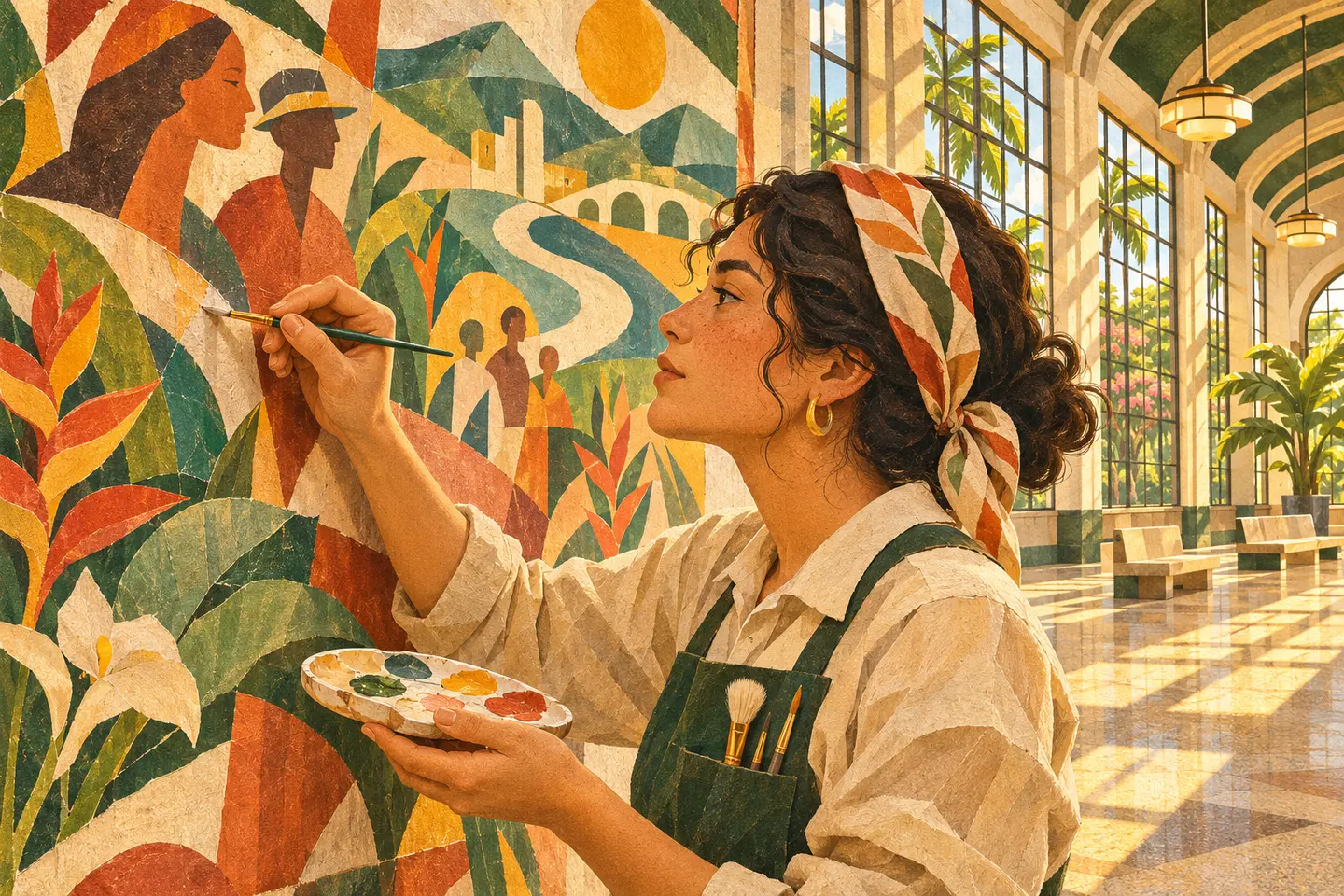
The International Alliance for the Protection of Heritage in Conflict Areas (ALIPH) will fund the stabilization of Historia de Cali (History of Cali) and Historia del Transporte (History of Transportation), Hernando Tejada’s murals in the former railway station. Fundación ERIGAIE will carry out the work in coordination with the Ministry of Culture, over a planned three months. The aim is to protect the paintings, damaged by August’s earthquake, through emergency conservation work.
An artist who made Cali his home
Tejada was born in Pereira in 1924 and moved to Cali with his family in 1937. Here he developed his interest in drawing and studied at Bellas Artes. His training continued in Bogotá, where he learned fresco painting from Ignacio Gómez Jaramillo. The artist’s biography describes a body of work spanning painting, sculpture, photography and audiovisual projects: different ways of observing and representing the world around him.
Two murals with a shared history
The chronology of his work places the station’s frescoes in the 1950s. For Historia de Cali, Tejada worked with painter Adriano Moreno and Ernesto Buzzi, who prepared the plaster. Each mural covers 190 square meters. The transport painting was damaged in the 1956 explosion and subsequently restored. Caring for these works is therefore part of a history of conservation that reaches across several generations in the city.
Art that remains part of everyday Cali
Tejada’s perspective also appears in his wooden sculptures, female figures and explorations of mangroves, wildlife and plants. Banrepcultural highlights the humor and playfulness found in parts of his work. In 1996, he donated El Gato del Río to Cali, a bronze sculpture that became a cultural landmark and a visitor attraction.
Exploring his drawings and sculptures reveals other sides of the artist and offers another way to understand his presence in Cali.