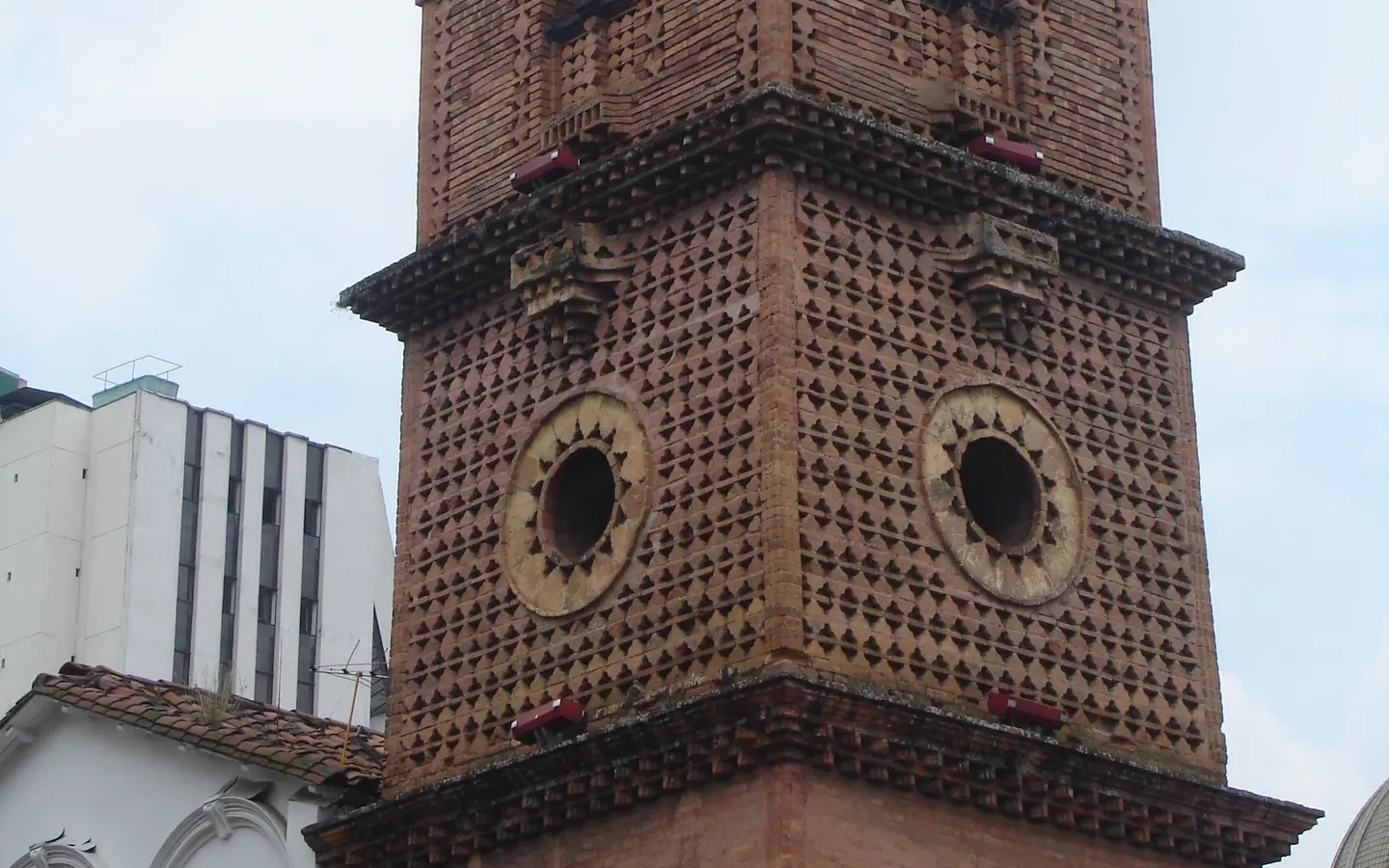
The two round windows in this photograph of Cali’s Torre Mudéjar look like little suns. Trace the edge of either one and you can see where the rays come from. The builders arranged bricks around the opening to form what art historian Santiago Sebastián described as a 15-pointed star. For decades, a coat of lime plaster hid their handiwork.
Where to look for the star
The bell tower stands beside the Capilla de la Inmaculada in downtown Cali. The San Francisco complex occupies the block between Calles 9 and 10 and Carreras 5 and 6. The tower rises about 23 meters (75 feet). To spot the star in a full view, find the arch that holds the bells, then look one level down. The round window at the star’s center is called an oculus.
Now look at the brickwork on either side. Rows of tiny arches run across the wall. To give each arch its three lobes, the builders paired trapezoid-shaped bricks along their wider edges. Sebastián describes the technique in his study of colonial architecture in the Valle del Cauca (opens in a new tab).
How the pattern came back to light in 1936
In an engraving published in América pintoresca (Picturesque America) in 1884 (opens in a new tab), you can pick out the star above the chapel roof. Around 1889, lime plaster covered the tower. Nineteenth-century prints preserved a clue to the design underneath.
In 1936, as Cali marked the 400th anniversary of its founding, historian Demetrio García Vásquez championed the tower’s restoration. Artist Luis Alberto Acuña removed the plaster and reshaped the arches at the top. The tower even appeared on a postage stamp commemorating the anniversary. Cali’s architectural heritage record (opens in a new tab) brings together historical views of the tower so you can compare them.
The bell tower also features in one proposed explanation for Cali’s nickname la Sultana del Valle, the Sultana of the Valley.