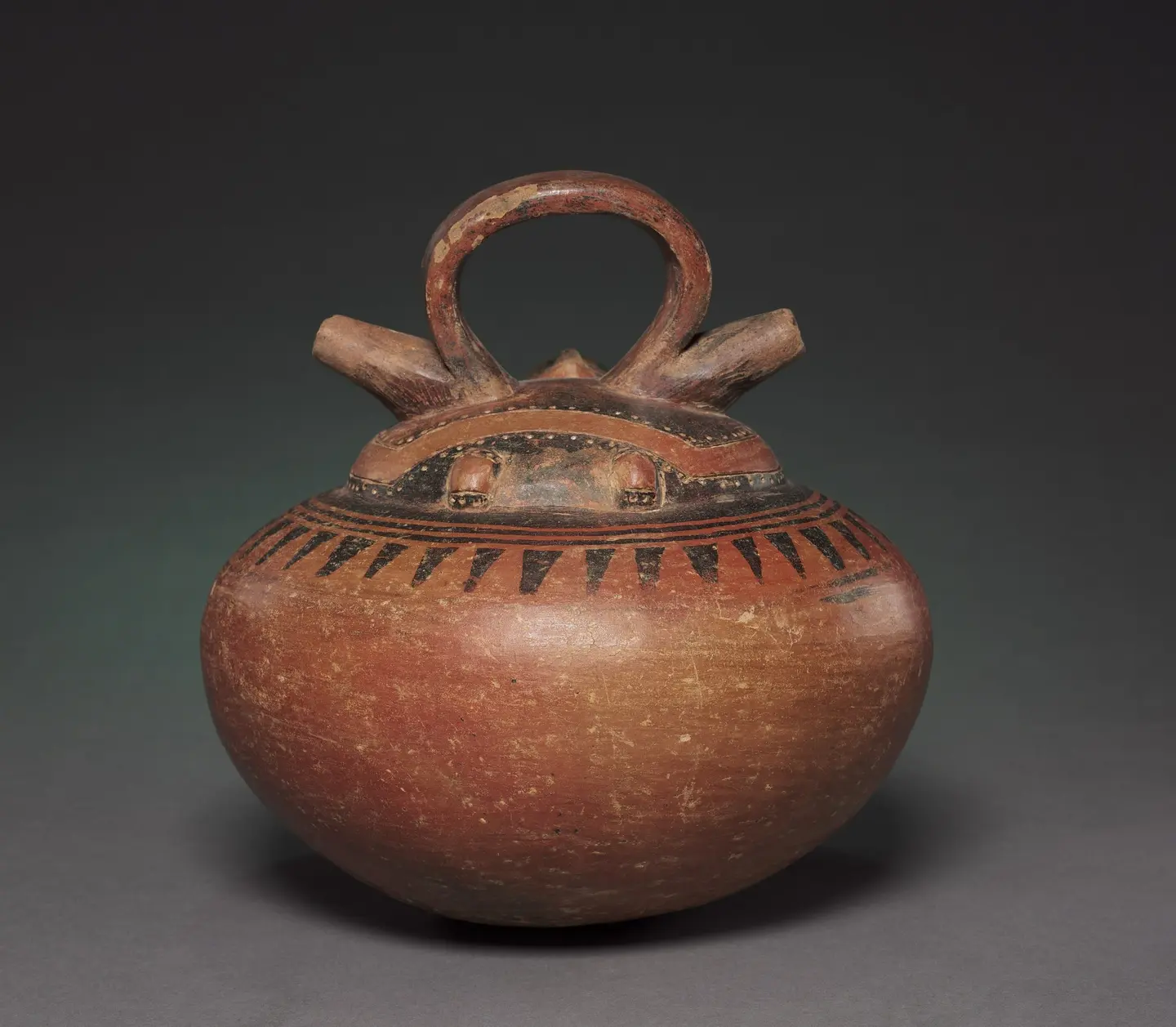
In January 2023, anyone running an errand at the Valle del Cauca government offices in downtown Cali could come across a clay pot that whistled. On display in the Palacio de San Francisco was an Ilama vessel called an alcarraza, decorated with an animal figure and drawn from the Calima Archaeological Museum’s collection. Behind glass, it was silent. To hear how pots like this worked, you had to fill them.
One spout let liquid in and the other let air out
Look just below the handle in the cover photograph. Two short tubes point out at an angle, one on each side. The Gold Museum describes how a pot with two spouts was filled by dipping it into a larger container. Liquid entered through one opening and forced the air inside out through the other. On some vessels, potters fitted a whistle at that exit. The escaping air supplied the breath.
People in southwestern Colombia used this design at least three thousand years ago. A harder question to answer is who drank from these vessels and on what occasions. The Gold Museum suggests that people may have used them in ceremonies.
An armadillo from Restrepo and a figure under the handle
Ilama potters sometimes shaped the entire vessel into an animal. Colombia’s central bank records one from Restrepo, in the Valle del Cauca, modeled as an armadillo. Other ceramics portray people wearing necklaces, with their hair combed into parallel lines or carrying a load on their backs.
The two-spout design outlasted the Ilama period. The vessel in the cover photo is a later Yotoco example from the Calima region, now in the Cleveland Museum of Art. It dates to the first through eighth centuries CE. Look beneath the arch of the handle and you can make out a small figure reclining across the rounded body.
To hear what clay can sound like, listen to the Gold Museum’s recording of whistles from the Calima region (opens in a new tab). In downtown Cali, the Calima Gold Museum is a place to see more of the work of Ilama and Yotoco artisans.
Sources
- INCIVA, announcement of the alcarraza exhibition in Cali, January 19, 2023 (opens in a new tab).
- Banco de la República Gold Museum, Calima teaching collection, 2006 (opens in a new tab).
- Banco de la República encyclopedia, “Calima,” accessed November 23, 2026 (opens in a new tab).
- Cleveland Museum of Art, collection record for the vessel with a reclining figure, accessed November 23, 2026 (opens in a new tab).
- Gold Museum, recording of whistles from the Calima region, April 25, 2018 (opens in a new tab).