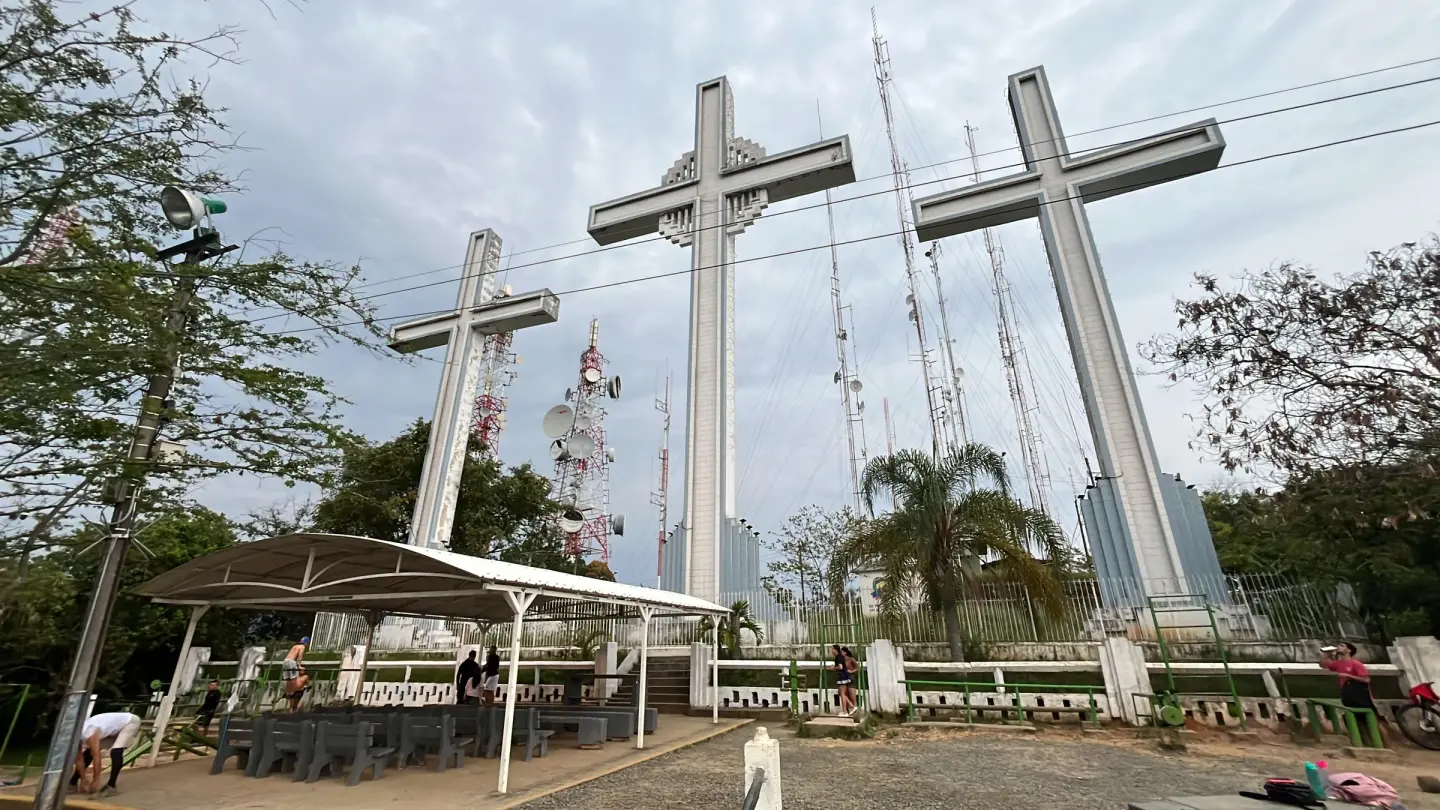
You can see them from almost anywhere in Cali: three white crosses on top of a hill in the northwest of the city. Many caleños (people from Cali) hike up for exercise or on pilgrimage. What few visitors know is that, according to legend, they’re not there just out of devotion: they’re there to keep a demon locked up. His name is Buziraco, and his story begins far from Cali, on a hill in Cartagena.
The legend: from La Popa, in Cartagena, to a hill in Cali
Like every legend, Buziraco’s story changes depending on who tells it. This is the most common version.
A demon from afar. Some say he was a demon banished from Spain who arrived by ship during the Conquest. Others say he was a spirit who traveled on slave ships to accompany enslaved Africans. Either way, he settled on La Popa hill in Cartagena.
The fight on La Popa. There he met Fray Alonso de la Cruz Paredes, an Augustinian friar who came to build a church to the Virgin. According to legend, the friar defeated him and drove him off the hill.
Arriving in Cali. Wounded, the demon fled southwest. Some say he arrived via Buenaventura; others say he wandered the mountains for years. Eventually he found a home on a hill in Cali.
The misfortunes. Over time, Cali was struck by plagues, swarms of locusts and fires on the hillsides. People said a smell of sulfur drifted down from the hill and that, on moonless nights, a giant bat could be seen at the summit. For the townspeople, it was all Buziraco’s doing.
The bamboo crosses. In 1837, the friars Vicente and Juan Cuesta climbed the hill and planted three crosses made of guadua, a local giant bamboo, at the summit to cast him out. According to legend, they didn’t manage to expel him: they only trapped him. Some versions say a deep voice rose from the hill, cursing the city.
The 1925 earthquake. When an earthquake toppled the bamboo crosses, many took it as a sign that Buziraco was free again. So the city decided to build crosses no earthquake could bring down.
Today, they say, the demon is still down there, locked beneath the concrete crosses.
In Cartagena, Buziraco may have been an Indigenous god
In Cartagena, Buziraco has his own story, and it’s quite different. According to historians Rodrigo Alfaro and Ubaldo Elles Quintana, quoted by El Universal in 2024, Buziraco may have been an Indigenous deity who protected the bay. He had a place of worship on La Popa hill and even a mestizo high priest, Luis Andrea, whom the Inquisition sentenced to row in the galleys.
For these historians, the “demon” idea was a product of evangelization: the worship of Indigenous people and cimarrones, Africans who had escaped slavery, was painted as the devil’s work, and the Virgin of La Candelaria became the city’s patron saint, with her convent on top of La Popa. The Cali legend picks up exactly where Cartagena’s ends: a demon defeated on one hill looks for another.
What history says: from bamboo in 1837 to concrete in 1938
Behind the legend are dates and facts that can be checked:
- 1837: according to Cali City Hall’s heritage record, the friars Vicente and Juan Cuesta placed three bamboo crosses on the summit to ward off evil. Since then, caleños have climbed the hill every May 3, the Day of the Holy Cross.
- June 7, 1925: an earthquake of magnitude close to 6.8 caused serious damage in Cali. According to tradition, it also toppled the bamboo crosses.
- 1937: Father Marco Tulio Collazos, parish priest of Santa Rosa, championed a permanent monument. Engineer Argemiro Escobar led the work with master builder Luis Felipe Perea.
- January 6, 1938: City Hall gives this as the date the reinforced-concrete crosses were handed over. The central cross is 26 meters high and 11 wide, and the side crosses are 22 by 8, on a 420-square-meter base.
A demon to the colonizers, a protector to the enslaved
In 2015, literature student Óscar Obando published a story in La Palabra, the Universidad del Valle newspaper, with a telling title: “Las dos caras de Buziraco. Héroe del negro y demonio del blanco” (Buziraco’s two faces: hero of the Black people, demon of the white people). His reading is that in Cali, Buziraco has two faces: the colonizers’ demon, blamed for every disaster, and the protective spirit who accompanied the enslaved and helped them keep their rituals alive.
That’s why the legend is worth reading with care. Several traditional versions describe the demon surrounded by Black people dancing to drums. That image says more about the prejudices of those who wrote the story than about the hill.
Today’s versions: a bat, a cell and a nightclub dancer
The legend is still alive and keeps gaining new details:
- The horned bat: Buziraco’s most cited form is a giant bat flying over the hill.
- The demon’s cell: El Tiempo reports the popular belief that it lies between the second and third crosses.
- The nightclub dancer: El País tells the urban legend of a man who dances far too well in a Cali nightclub and asks people not to look at his feet, because they’re goat’s hooves.
A curious fact: according to La Palabra, in Cartagena he was also called “Garabato.” It has nothing to do with the Garabato of América de Cali’s famous curse, which we tell in our history of Cali’s football derby, but in Cali both Garabatos come with a curse.
Hiking the hill: 480 meters of climbing, free entry
If you want to see the crosses up close, it’s a demanding hike: about 480 meters of elevation gain on dirt and rock trails, to a summit at 1,465 meters. It’s free.
- When to go: early in the morning, ideally on a weekend, when more groups are hiking. Don’t come down after dark.
- On pilgrimage: every May 3 and during Holy Week. In 2026, more than 8,000 people climbed it on Holy Thursday and Good Friday, according to City Hall.
- Safety: there have been robberies on the trails. Hike in a group, carry only what you need and tell someone which route you’re taking.
- Routes and tips: see our Tres Cruces hill guide.
How was it told to you?
Buziraco isn’t told the same way in every Cali home. Email us at chrisavendano0508@gmail.com and tell us how you heard it: who told you, how the ending changed or whether you ever felt something strange hiking up the hill.
Frequently asked questions
What is Buziraco?
According to legend, a demon driven off La Popa hill in Cartagena who came to Cali and took refuge on the hill where the Tres Cruces stand today.
Why are there three crosses on the hill?
According to tradition, in 1837 the friars Vicente and Juan Cuesta placed three bamboo crosses there to ward off Buziraco. After the 1925 earthquake reportedly toppled them, they were replaced by today’s reinforced-concrete crosses, handed over in 1938.
Was Buziraco really a demon?
It depends on who’s telling it. In Cali’s legend he’s a demon, but Cartagena historians argue he was a protective Indigenous deity, turned into a demon by evangelization.
How tall are the Tres Cruces?
The central cross is 26 meters high and 11 wide, and the side crosses are 22 meters high and 8 wide.
When do people climb the Tres Cruces on pilgrimage?
Every May 3, the Day of the Holy Cross, and during Holy Week.
Sources
- Cali City Hall — heritage inventory record for the Cerro de las Tres Cruces (in Spanish) (opens in a new tab).
- Cali City Hall — Las Tres Cruces, history and the May 3 tradition (in Spanish) (opens in a new tab).
- Cali City Hall — more than 8,000 people climbed the Tres Cruces hill on Holy Thursday and Good Friday, 2026 (in Spanish) (opens in a new tab).
- La Palabra, Universidad del Valle — Buziraco’s two faces, Óscar Obando, August 1, 2015 (in Spanish) (opens in a new tab).
- El Universal — the misunderstood story of Buziraco, the god who appeared on La Popa, February 3, 2024 (in Spanish) (opens in a new tab).
- Infobae — Buziraco, the Spanish demon who came to Cartagena and was driven off in Cali, March 26, 2024 (in Spanish) (opens in a new tab).
- El Tiempo — the Tres Cruces hill in Cali and the myth of Buziraco, July 28, 2023 (in Spanish) (opens in a new tab).
- El País Cali — A curse? The story behind Cali’s three crosses, July 25, 2023 (in Spanish) (opens in a new tab).
- El País Cali — Tale or truth? The stories that have scared Cali for years, October 30, 2013 (in Spanish) (opens in a new tab).
- Mitos de Colombia — Buziraco and Cali’s Tres Cruces, reviewed September 22, 2026 (in Spanish) (opens in a new tab).
- Journal of the Colombian Academy of Sciences (Raccefyn) — macroseismic analysis of the June 7, 1925 earthquake in Cali, 2007 (in Spanish) (opens in a new tab).
- CaliSucursal — Tres Cruces hill guide, data reviewed November 12, 2026.