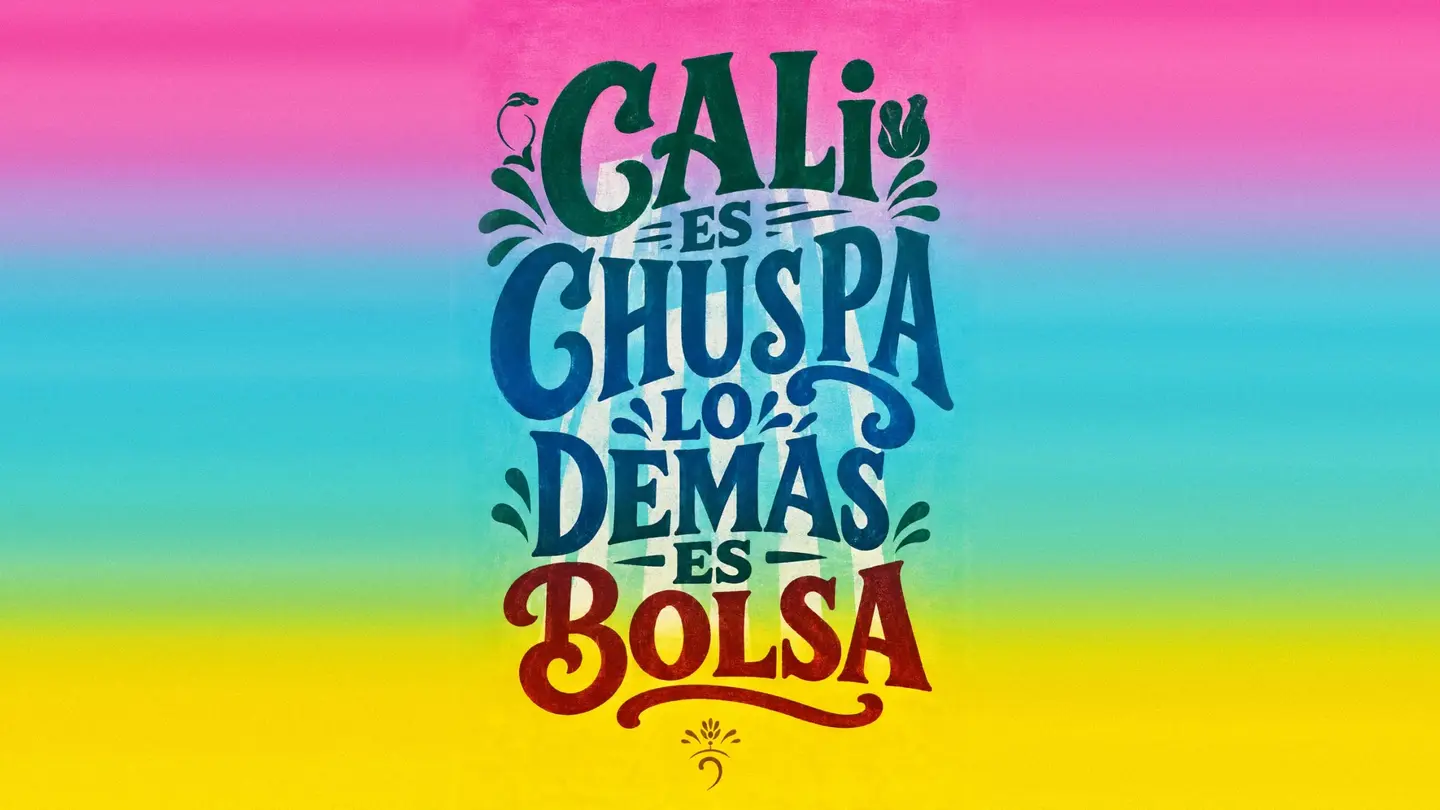
Mirá, ve: if you come to Cali, you’ll hear words you won’t find in any Spanish course. This pocket dictionary collects 32 Cali slang words and phrases, with what each one means and an example of how to use it, and explains where the city’s vos, its “s” that turns into an “h” and the pam at the bakery come from.
People from Cali, the caleños, have a rhythmic accent, a vos they never let go of and their own vocabulary, learned on the street, at the corner store and on the dance floor. Each entry below has an example in Spanish, followed by its English translation. Missing a word? At the end, we tell you how to send it to us.
The accent: vos, the “s” that turns into an “h” and pam
Voseo: vos sabés
In Cali, people say vos instead of tú for “you”: vos sabés (“you know”), vení (“come here”), mirá (“look”). According to Cali-born linguist Ana María Díaz Collazos, who holds a PhD in Hispanic linguistics, voseo arrived from southern Spain in colonial times; it disappeared there but stuck in the Valle del Cauca. In her view, its survival shows there has been more contact here between the upper and lower classes. Mirá and ve come from mirad and ved, 16th-century Spanish forms that lost their final “d” in the singular.
Researcher Germán Patiño traced mirá, ve and oís to the Afro-descendant nannies who raised the children of the region’s hacienda owners: their soft Spanish, with clipped words, was the first those children heard, and it became the speech of the whole region.
Voseo isn’t unique to Cali: it’s also used in Antioquia, the Coffee Region, Cauca and Nariño. What makes it sound like Cali is the pronunciation.
Traveler tip: you don’t need to use vos yourself. Everyone understands tú and usted, but recognizing vos will help you follow conversations.
The “s” that turns into an “h”
This is the most distinctive feature of the Cali accent: between vowels, the “s” sounds almost like the Spanish “j”, a soft “h”. So ¿vas a ir? (“are you going?”) becomes ¿vajaír?, and vos sabés becomes vojabés. According to Díaz Collazos, a change that happens only between vowels is very rare in the rest of the Spanish-speaking world.
When pan becomes pam
A final “n” sometimes sounds like an “m”, which is why some caleños ask for pam (bread) at the bakery. According to Díaz Collazos, outside Cali this only happens in Yucatán, Mexico.
To get someone’s attention: ve, mirá ve and oís
Ve
Pronounced “veh”, it’s the most Cali word of all. It gets someone’s attention, like “hey” or “look”, at the start or end of a sentence.
«Ve, ¿y vos a qué hora llegás?»: “Hey, what time are you getting here?”
Mirá ve
Literally “look, see”. It’s redundant on purpose: it’s how caleños say “listen up”. Cali’s city hall calls it “a motto in its own right”.
«Mirá ve, esa salsa es de Niche.»: “Hey, listen, that salsa song is by Niche.”
¿Oís?
Pronounced “oh-EES”, literally “do you hear?”. Caleños use it to get attention or to check that you’re listening, like “you know?” or “right?”.
«Vamos a bailar ahorita, ¿oís?»: “We’re going dancing in a bit, okay?”
Greetings and goodbyes: quiubo and nospi
Quiubo
The classic casual greeting, short for ¿qué hubo?, “what’s up?”.
«¡Quiubo, pues! ¿Cómo vas?»: “Hey there! How’s it going?”
Nospi
Short for nos pillamos: “see you later”.
«Bueno, me voy. ¡Nospi!»: “Okay, I’m off. See ya!”
Plans and partying: borondo, chingue, desparche and parche
Borondo
A short stroll, a little walk around.
«Vamos a dar un borondo por el Bulevar del Río.»: “Let’s take a stroll along the riverside boulevard.”
Chingue
A change of clothes or a swimsuit for a river trip, especially to the Pance River.
«No se te olvide el chingue, que vamos pa’ Pance.»: “Don’t forget your swimsuit, we’re going to Pance.”
Desparche or desparchado
When there’s nothing to do and you’re bored.
«Qué desparche este domingo.»: “What a boring Sunday.”
Descualquierarse
The opposite of desparche: going out to party, dance and have fun.
«Este sábado nos vamos a descualquierar.»: “This Saturday we’re going to let loose.”
Enchusparse
Staying home, holed up indoors.
«Llovió y me enchuspé todo el día.»: “It rained, and I stayed in all day.”
Yenyeré
Another word for a party.
«¿Hay yenyeré esta noche o qué?»: “Is there a party tonight or what?”
Parche
Your group of friends, or the plan. It’s used all over Colombia, but in Cali it’s essential.
«Mi parche se va a la Feria.»: “My crew is going to the Feria.”
Gallada
A group of young people, your gang of friends.
«Llegó toda la gallada.»: “The whole gang showed up.”
To say something is great (or not so great): áspero, mundial, uva and peye
Áspero
Something really nice, impressive or striking. Like “awesome”.
«¡Qué áspero ese mirador de Cristo Rey!»: “That Cristo Rey viewpoint is awesome!”
Calidoso
Cool, good quality, warm and interesting. It can describe a thing or a person.
«Ese profe es muy calidoso.»: “That teacher is really great.”
Mundial
Literally “world-class”: the best.
«Ese cholado estaba mundial.»: “That cholado was amazing.”
Uva
Literally “grape”: perfect. Something done flawlessly is left como una uva, “like a grape”.
«¿Nos vemos a las ocho? Uva.»: “See you at eight? Perfect.”
Pinchado
Elegant, dressed up. Also said pinchao.
«Llegó todo pinchado a la fiesta.»: “He showed up to the party all dressed up.”
Picado
Stuck-up, full of themselves.
«No le hagás caso, que es muy picado.»: “Don’t pay attention to him, he’s really stuck-up.”
Peye
Bad quality, something that doesn’t live up to its promise.
«Esa sombrilla salió peye.»: “That umbrella turned out to be junk.”
Choneto
Badly made, clumsy.
«Quedó medio choneto el arreglo.»: “The repair came out kind of shoddy.”
Everyday words: chuspa, ñapa, pancacho and cholao
Chuspa
A bag, plastic or paper. For a caleño, there are no bolsas, only chuspas. The word comes from Quechua, where it named the small pouch Indigenous people used to carry coca leaves. According to Díaz Collazos, only Cali uses it to mean a plastic bag.
«¿Me regala una chuspa, por favor?»: “Could I have a bag, please?”
Ñapa
A little extra, the small bonus a vendor throws in for free.
«Le eché dos mangos de ñapa.»: “I threw in two extra mangoes for you.”
Pancacho
What people in Cali call a croissant.
«Un tinto y un pancacho, por favor.»: “A black coffee and a croissant, please.”
Cholao
How Cali pronounces cholado: shaved ice with chopped fruit, syrup and condensed milk. We tell you where to try it in our guide to what to eat in Cali and in our guide to the cholado stands at the Canchas Panamericanas.
«Vamos por un cholao a la Calle 9.»: “Let’s get a cholado on Calle 9.”
Pelado or pelada
A young man or woman, a kid.
«Ese pelado baila durísimo.»: “That kid dances really well.”
Feelings and situations: culillo, chichonera and bororó
Culillo
Fear.
«Me dio culillo subir sola a las Tres Cruces.»: “I was scared to hike up to Las Tres Cruces alone.”
Chichonera
A chaotic situation, a mess.
«A la salida del estadio eso es una chichonera.»: “Leaving the stadium is total chaos.”
Bororó
A problem, a fuss. On the Caribbean coast, they say bololó.
«Se armó tremendo bororó.»: “A huge fuss broke out.”
Phrases to sound like a local: vojabés, oigan a mi tío and a la parte seria
Vojabés
Besides being how caleños pronounce vos sabés, it’s an expression of pride, like “you know it”. If someone tells you «los caleños son muy alegres» (“caleños are so cheerful”), the right answer is: «Ah, vojabés».
Oigan a mi tío
Literally “listen to my uncle”. It’s what you say when someone is talking nonsense.
«¿Que la salsa nació en Bogotá? Oigan a mi tío.»: “Salsa was born in Bogotá? Yeah, right.”
A la parte seria
Literally “on the serious side”: used to show you mean it.
«A la parte seria, mañana te pago.»: “Seriously, I’ll pay you tomorrow.”
Want more? Caleño sin barreras has 1,016 words
If you want to go further, there’s Caleño sin barreras (Caleño Without Barriers), a pocket dictionary by Diana Marcela Cuartas, a social communication graduate of the Universidad del Valle. Its second edition collects 1,016 words of Cali slang, with their meanings. Several of the words on this list also appear in it.
Missing a word? Send it to us
Cali speech changes with every generation and every neighborhood. Email us at chrisavendano0508@gmail.com with your favorite word or expression, what it means and an example of how it’s used. We’ll keep adding readers’ suggestions to this dictionary. Nospi, ¿oís?
Frequently asked questions
What does ve mean in Cali?
It’s a way of getting someone’s attention, like “hey” or “look”. It’s often used in the phrase mirá ve.
What is a chuspa?
A bag, plastic or paper. The word comes from Quechua.
Why do people in Cali say vos?
Voseo came from southern Spain in colonial times. It disappeared there but survived in Cali and other regions of Colombia.
Why does the “s” sound like an “h” in Cali?
Between vowels, the “s” is aspirated and sounds almost like a soft “h”: ¿vas a ir? comes out as ¿vajaír?. According to linguist Ana María Díaz Collazos, it’s inherited from the Spanish of Andalusia, in southern Spain.
What does oís mean?
It’s a way of getting attention or checking that someone is listening, like “you know?” or “right?”. It’s one of the most typical words in Cali speech.
What does nospi mean?
It’s short for nos pillamos: “see you later”.
Sources
All sources are in Spanish.
- Cali city hall — 10 Cali expressions you need to know to understand us, July 4, 2019 (opens in a new tab).
- El País Cali — The dictionary of caleñidad, July 25, 2014 (opens in a new tab).
- El País Cali — The dictionary of Cali Spanish has arrived, January 7, 2016 (opens in a new tab).
- El País Cali — Cali’s birthday: the most Cali phrases and expressions in a dictionary, July 24, 2025 (opens in a new tab).
- El País Cali — Why caleños talk the way they do, April 22, 2012 (opens in a new tab).
- El País Cali — Vojabés: why caleños talk like this, as explained by a linguist, July 5, 2015 (opens in a new tab).
- Radiónica — The origin of the Cali accent and the meaning of its words, August 5, 2019 (opens in a new tab).
- Noticias Caracol — Colombia’s best-known accents around the world, October 22, 2024 (opens in a new tab).