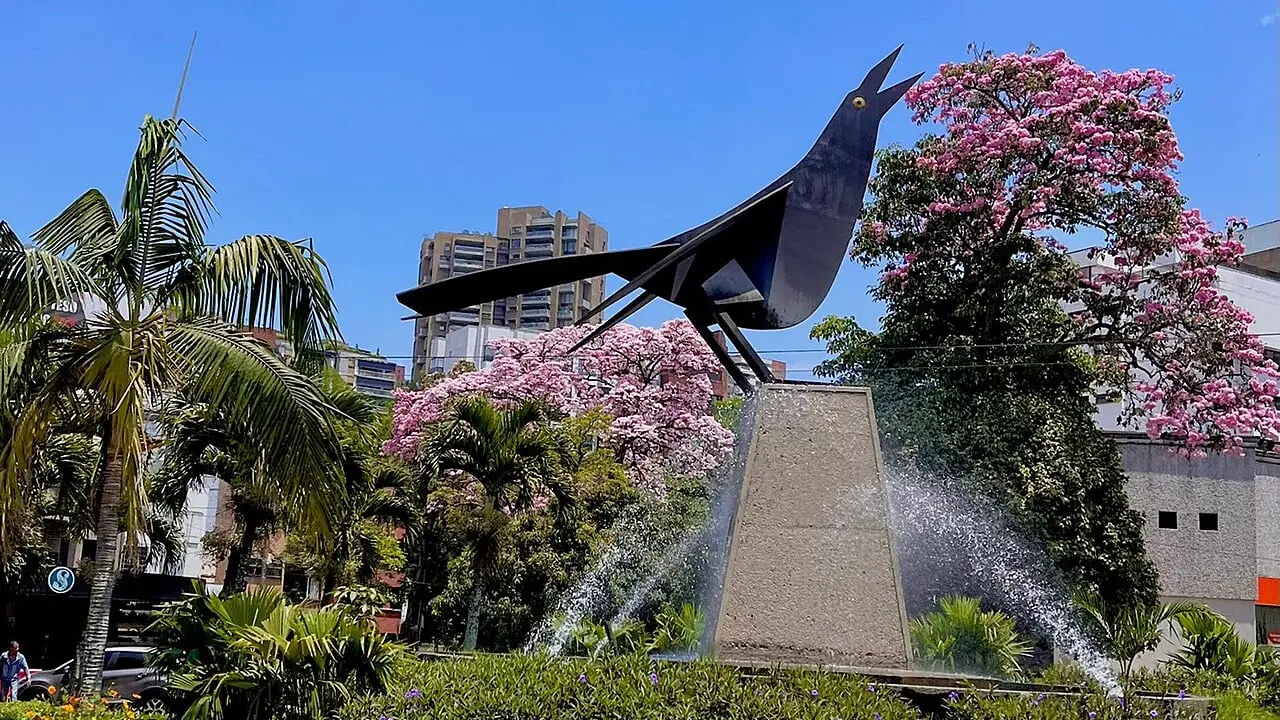
Cali has no seasons, but it does have a spring. The guayacanes bring it: over 17,000 trees, according to Dagma, Cali’s environmental authority. Their main season runs from July to September, peaking in August and September. One day the trees drop their leaves and, within days, streets, parks and medians fill with pink, yellow and white blossoms. Beneath each tree lies a carpet of petals.
Key facts
- How many: over 17,000, according to Dagma: more than 10,000 pink, about 2,400 yellow and a handful of white.
- Main season: July to September, peaking in August and September.
- Second bloom: many guayacanes bloom again during the year’s other shift from dry to rainy season, in the first half of the year, with no fixed date. In 2023, El País and Occidente showed them in bloom in January and February; in 2026, El País reported them flowering in early May.
- Where there are the most: in comunas (city districts) 2, in the north, and 17, in the south, according to Dagma. Comuna 17 is also the city’s most tree-covered district.
- How long it lasts: each tree blooms for only a few days; the yellow guayacán for five to ten. Since they don’t all bloom at once, the season moves through the city like a wave.
They bloom as the dry season gives way to the rains
Guayacanes are deciduous: they lose their leaves for part of the year. They’re typical of the tropical dry forest, the original ecosystem of the valley where Cali sits.
According to Dagma, Cali has two dry and two rainy seasons a year. During the dry spell, guayacanes drop their leaves to save water and, right at the shift to the rains, they all bloom together, drawing on the water and energy they stored. Mass flowering helps them attract many pollinators at once, such as bees, wasps and birds, and produce more seeds.
That’s why people in Cali say the guayacanes announce the rain: when the city turns pink, the water is on its way.
Dagma warns that climate change is altering that cycle: irregular rain and temperatures affect how the trees bloom and reproduce, and with them the food supply of the wildlife that depends on their flowers.
Pink, yellow, white and purple: the trees of the season
- Pink guayacán (Tabebuia rosea), also called pink trumpet tree: the star. It’s the most common in Cali, with over 10,000 trees, and gives the city its pink glow.
- Yellow guayacán (Handroanthus chrysanthus), also called golden trumpet tree: about 2,400 trees, in an intense yellow. Don’t confuse it with the chicalá, another yellow-flowered tree that some regions also call guayacán: the yellow guayacán has bell-shaped flowers with reddish lines in the throat and blooms almost leafless, while the chicalá’s flowers grow in clusters at the tips of the branches.
- White guayacán (Tabebuia roseoalba): the rarest. Dagma’s census records only a handful.
- Gualanday (Jacaranda mimosifolia): not a guayacán, but it blooms at the same time and adds purple to the landscape. There are over 4,400 in the city.
Other species bloom in the same season, such as the queen’s flower and the golden shower tree.
Where to see them: Avenida 4 Norte, Bulevar del Río, comunas 2 and 17, and Pance
- Avenida 4 Norte: one of the corridors that turns pinkest. El País walked it in full bloom on September 1, 2025.
- Bulevar del Río: the pink guayacanes along the Cali River have their season too; El País published photos of them in January 2023. To plan your walk, see our Bulevar del Río guide.
- Comunas 2 and 17: these districts in the north and south have the most guayacanes. Walking their parks and medians in season is a plan in itself.
- Ecoparque de la Biodiversidad, in Pance: on September 10, 2026, 156 pink guayacanes were planted there in memory of the earthquake victims. According to City Hall, they’ll reach full bloom in three to five years. Hours and trails for the eco-park are in our Pance River guide.
Tips for the best photo
- Go early or late in the afternoon: soft light makes the pink and yellow glow.
- Look down: the carpet of blossoms beneath the trees is as beautiful as the canopy.
- Look for contrast: a pink guayacán against a blue sky, or next to a white building, is the classic shot.
- Don’t pull off flowers or branches: the petals that have already fallen are all you need for the photo.
December isn’t guayacán season
Let’s be honest: November and December aren’t guayacán months. If you come for the Feria de Cali, you may spot one in bloom, but not the city painted pink. If you want the full season, plan your trip between July and September: it covers Cali’s birthday on July 25 and the Petronio Álvarez Pacific music festival, usually held in August.
They bloomed days after the 2026 earthquake
In 2026, the guayacanes bloomed days after the August 10 earthquake. Dagma shared a message that went viral: “Cali, you will bloom again. Like our guayacanes, which fill with color again after every season, we too will rise.” If you’re planning a trip at the end of the year, here’s how Cali’s landmarks are doing after the earthquake.
How to protect them: don’t harm them, and check with Dagma before planting
- Don’t harm them: cutting, pruning without a permit or poisoning a tree in a public space carries penalties. In 2024, Dagma opened sanction proceedings against whoever tried to poison a guayacán in the Tequendama neighborhood with used motor oil. If you see a case, report it to Dagma.
- If you want to plant one: check with Dagma first, which recommends the right species and spot to avoid problems with sidewalks and utility lines. The city nursery, the Vivero Distrital, gives away plants to people who commit to planting and caring for them in public spaces.
What’s your favorite guayacán?
Is there a guayacán on your block that everyone waits for each year? Email us at chrisavendano0508@gmail.com and tell us where it is. If you have a photo from the season, we’d love to see it.
Frequently asked questions
When do the guayacanes bloom in Cali?
The main season runs from July to September, peaking in August and September. Many trees bloom again during the other dry-to-rainy shift, in the first half of the year. Dates vary with the weather.
Why do guayacanes lose their leaves before blooming?
Because they’re deciduous: they drop their leaves in the dry season to save water and focus their energy on flowering.
How many guayacanes are there in Cali?
Over 17,000, according to Dagma. Most are pink.
Where can I see guayacanes in Cali?
On Avenida 4 Norte, along the Bulevar del Río and in the parks and medians of comunas 2 and 17, the districts with the most guayacanes.
How long does a guayacán bloom last?
Each tree blooms for only a few days; the yellow guayacán for five to ten. Since they don’t all bloom on the same day, the season in the city lasts several weeks.
Sources
- Cali City Hall (Dagma) — Over 17,000 guayacanes bloom and color Cali’s streets (in Spanish), September 11, 2025 (opens in a new tab).
- Cali City Hall (Dagma) — 20,691 “natural artists” give Cali a colorful show for its birthday (in Spanish), July 21, 2025 (opens in a new tab).
- Cali City Hall (Dagma) — One of the natural shows caleños love most has begun (in Spanish), July 21, 2023 (opens in a new tab).
- Cali City Hall — The COP16 Biodiversity Park honors earthquake victims by planting 156 pink guayacanes (in Spanish), September 10, 2026 (opens in a new tab).
- Cali City Hall (Dagma) — Attempt to poison a guayacán tree in the Tequendama neighborhood (in Spanish), September 9, 2024 (opens in a new tab).
- Cali City Hall (Dagma) — Cali’s green future is planted at the Vivero Distrital (in Spanish), March 7, 2025 (opens in a new tab).
- El País Cali — Cali blooms: the city that invented its own spring with the guayacanes (in Spanish), September 11, 2025 (opens in a new tab).
- El País Cali — A rain of flowers in Cali, the natural spectacle of the guayacanes (in Spanish), September 1, 2025 (opens in a new tab).
- El País Cali — Guayacanes in Cali: the bloom that coincides with Japan’s sakura (in Spanish), May 4, 2026 (opens in a new tab).
- El País Cali — Photos of the guayacanes turning the Bulevar del Río pink (in Spanish), January 24, 2023 (opens in a new tab).
- Occidente — Guayacanes color Cali (in Spanish), February 7, 2023 (opens in a new tab).
- Occidente — Guayacanes in Cali: how many there are, why they bloom and how to protect them (in Spanish), September 15, 2025 (opens in a new tab).
- El Espectador — At what age does the yellow guayacán bloom, and how often? (in Spanish), April 25, 2026 (opens in a new tab).
- El Espectador — September turns yellow: three trees that paint the landscape (in Spanish), September 22, 2025 (opens in a new tab).
- Infobae — Viral images of Cali’s guayacanes after the earthquake: “Cali, you will bloom again” (in Spanish), August 20, 2026 (opens in a new tab).